Rockstone
Water
Home of the Kinich Ahau Jade Head—the singular most important archaeological treasure in Belize.
The Gateway City
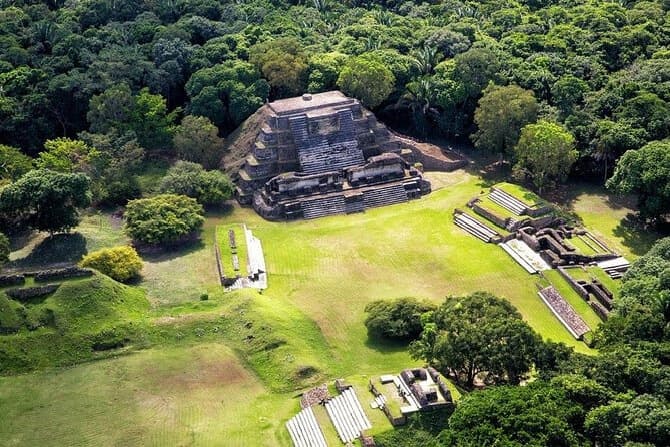
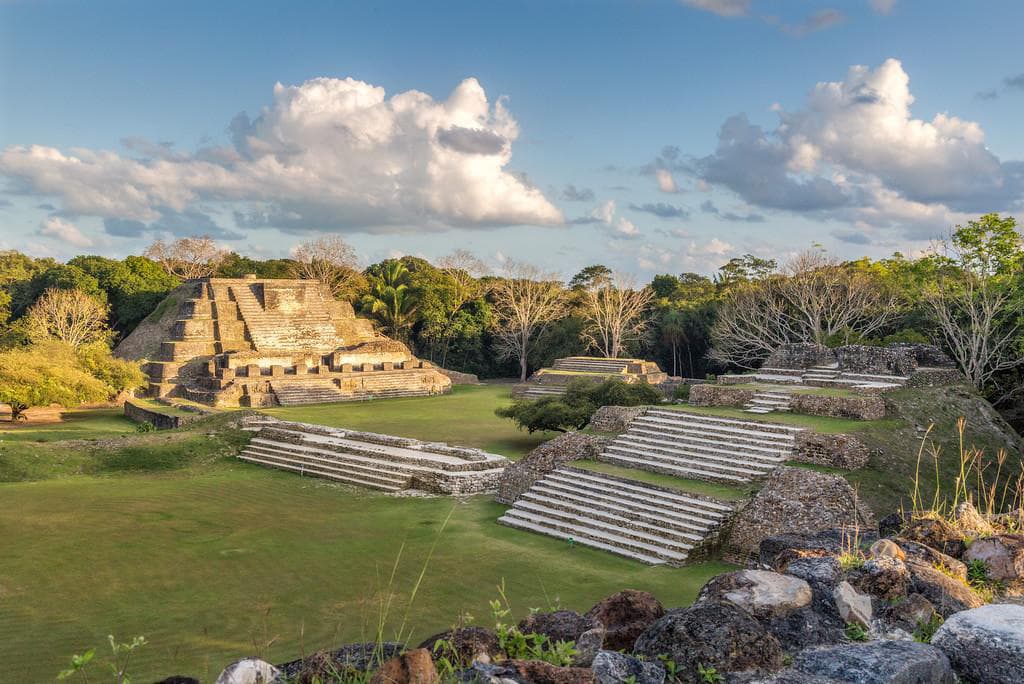
Altun Ha (Rockstone Water) is perhaps the most accessible and iconic archaeological site in Belize. Located just 31 miles north of Belize City, it served as a vital link between the resources of the Caribbean Sea and the burgeoning city-states of the interior. While it may not have the sprawling acreage of Caracol, its architectural precision and the sheer value of its burials mark it as a center of immense wealth and religious power.
In this 2,000-word definitive guide, we explore the dramatic discovery of the Jade Head, the architectural significance of the Temple of the Masonry Altars, and the site's role as a coastal trade superpower.
The Jade Head
9.75 lbs of solid Jadeite, representing the Sun God, Kinich Ahau.
Kinich Ahau:
The Sun God
In 1968, Dr. David Pendergast of the Royal Ontario Museum made a discovery that would resonate globally. Within a tomb in the Temple of the Masonry Altars, he found the Jade Head. Measuring 6 inches tall and weighing nearly 10 pounds, it remains the largest carved jade object ever found in the Mayan world. It depicts the head of Kinich Ahau, the sun god, with the distinctive crossed eyes and flared nostrils associated with Mayan deity iconography.
The Temple of Masonry Altars
The largest structure at Altun Ha, this temple rises 54 feet and was the primary ceremonial center of the city. Its namesake "Altars" were stone platforms used for specialized rituals, where elite practitioners would communicate with the divine. The temple's profile is so iconic that it has been immortalized as the primary logo for Belikin Beer—Belize's national beverage.
54 ft
Apex Height
7 Tombs
Major Burials
600 AD
Peak Prosperity
Coastal Geopolitics: The Trade of Obsidian and Shell
Altun Ha's prosperity was not accidental. It was a strategic choice. While sites like Caracol were landlocked superpowers, Altun Ha sat at the intersection of the marine and terrestrial worlds. Archaeological excavations have revealed an incredible volume of "exotic" items: obsidian from the Guatemalan highlands, volcanic ash for pottery temper, and hundreds of thousands of shell beads and ornaments from the Caribbean coast. This indicates that Altun Ha served as a "middleman," processing and redirecting wealth through a complex network of coastal canoes and inland foot-portage. This trade-heavy economy allowed the Altun Ha elite to live in nearly unparalleled luxury, as evidenced by the high concentration of jade and fine ceramics in their burials.
The Kinich Ahau Cult
The prevalence of the Sun God iconography at Altun Ha suggests that the city was a center for a specific solar cult. Modern archaeological theory posits that the ruling lineage of Altun Ha claimed direct descent from Kinich Ahau, using this divine lineage to justify their control over the trade routes. The ritual sacrifice and subsequent burial of the Jade Head was likely an act of "renewing the cosmos" or honoring a particularly powerful ruler upon their death. The fact that such a massive jade object was buried—removing it from the economy forever—is a testament to the immense religious capital the city possessed.
Post-Classic Resilience
Like Lamanai, Altun Ha showed a remarkable ability to survive the broader collapse of the Maya civilization. While the monumental construction phase ended around 900 AD, there is evidence of people living in the plazas and even performing rituals around the decaying temples as late as the 14th century. This "ruralization" of the site indicates that the agricultural and marine resources of the area were so abundant that they could support a community long after the central political power had evaporated. The history of Altun Ha is not just one of grand architecture, but of the persistent human adaptation to the Belizean environment.
Visitor Pro-Tips: Beating the Cruise Crowds
Because of its proximity to Belize City, Altun Ha is the primary destination for cruise ship excursions. To experience the site's true serenity, we recommend planning your visit for either early morning (8:00 AM) or after 2:30 PM. Most tour buses depart by mid-afternoon, leaving the plazas silent and the Howler Monkeys active. The site's manicured lawns and open spaces make it one of the "cleanest" feeling ruins in Belize, perfect for those who want to see archaeology without a three-hour hike through dense mud and jungle.
Culture & Identity
More Than Just a Label
The image of Altun Ha is etched into the daily life of every Belizean. Beyond the Belikin bottle, the Jade Head appears on every $20, $50, and $100 Belizean banknote. It is the definitive symbol of Belize's ancient pedigree and its modern pride. When you visit Altun Ha, you aren't just visiting a ruin; you are visiting the heart of a national brand.
Touch the
Iconic.
Witness the site that defines Belizean history. Plan your expert-led Altun Ha excursion today.