The Great
Blue Hole
A vertical abyss in the heart of the Belize Barrier Reef.
Into the Deep Blue
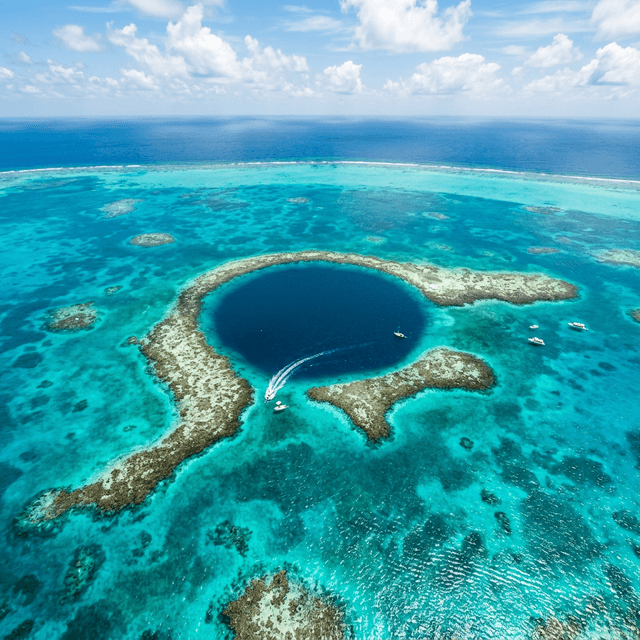
Visible from space, the Great Blue Hole is arguably Belize's most iconic landmark. This massive underwater sinkhole, located near the center of Lighthouse Reef, measures over 1,000 feet across and 400 feet deep. It's a dark blue circle of water surrounded by a shallow ring of turquoise coral, creating a contrast so sharp it looks surreal.
Made famous by Jacques Cousteau in 1971, who declared it one of the top five scuba diving sites in the world, the Hole has since become a pilgrimage site for divers and a "bucket list" item for travelers worldwide. Whether you explore it from beneath the surface or from the cockpit of a small plane, it is an experience that defies description.
Giant Stalactites
Ancient formations 130 feet below the surface.
Diving the
Abyss
Diving the Great Blue Hole isn't about colorful coral or teeming schools of fish—it's about the sheer scale and the eerie silence of the deep. At around 130 feet, divers encounter massive stalactites suspended from the ceiling of ancient caves, some reaching over 30 feet in length. These formations prove that the hole was once a dry cave system on land before rising sea levels submerged it.
The Aerial Spectacle
While diving offers an intimate look at the Hole's geology, nothing beats the aerial perspective for appreciating its perfect geometry. Scenic flights depart regularly from Belize City, Caye Caulker, and San Pedro. From the air, the transition from the vibrant turquoise of the reef to the deep, midnight blue of the hole is breathtaking.
Scenic Flights
1-Hour Tours
Photography
Perfect Angles
Experience
Bucket List
A Geological Time Capsule
The Great Blue Hole is a "vertical karst sinkhole." During the last ice age, when sea levels were significantly lower, it was a massive cave system. Rainwater seeped through the limestone, carving out vast chambers and forming the stalactites we see today. When the ice caps melted and sea levels rose, the cave system flooded, and the roof eventually collapsed, leaving the perfect circle we see today.
Recent expeditions, including one featuring Sir Richard Branson and Fabien Cousteau (Jacques' grandson), have used high-tech sonar and submersibles to map the bottom. They discovered hydrogen sulfide layers where no oxygen exists, creating a "graveyard" for sea creatures that accidentally wander too deep.
Planning Your Visit
Diving: You must be at least Advanced Open Water certified or have significant deep-dive experience. The descent to the stalactites is deep, and the time spent at depth is very short.
Snorkeling: While less intense than diving, snorkeling allows you to see the vibrant life on the shallow rim. You'll often see reef sharks, turtles, and tropical fish.
When to Go: The best visibility is during the dry season (February to May). However, boat trips are weather-dependent and can be canceled if the sea is too rough for the 2-3 hour journey to Lighthouse Reef.
Explore the
Deep.
Witness the majesty of the Great Blue Hole from above or below.