Submerged
Crocodile
A journey through the serpentine New River to the ancient city of Lamanai, where history and nature entwine.
The New River Safari
The experience of Lamanai begins long before you touch its stones. The primary route to the site is a 26-mile boat journey up the New River from Orange Walk Town. This is not merely transportation; it is an immersive wildlife safari through one of Belize's most productive riverine ecosystems. As the boat weaves through thick mangrove forests and open lagoons, you are transported into a landscape that has changed little since the Maya first paddled these waters 3,000 years ago.
In this 2,000-word authoritative guide, we explore the spectacular architecture of Lamanai, the rich biodiversity of the New River, and the site's unique status as one of the longest-occupied cities in the Mayan world.
The Mask Temple
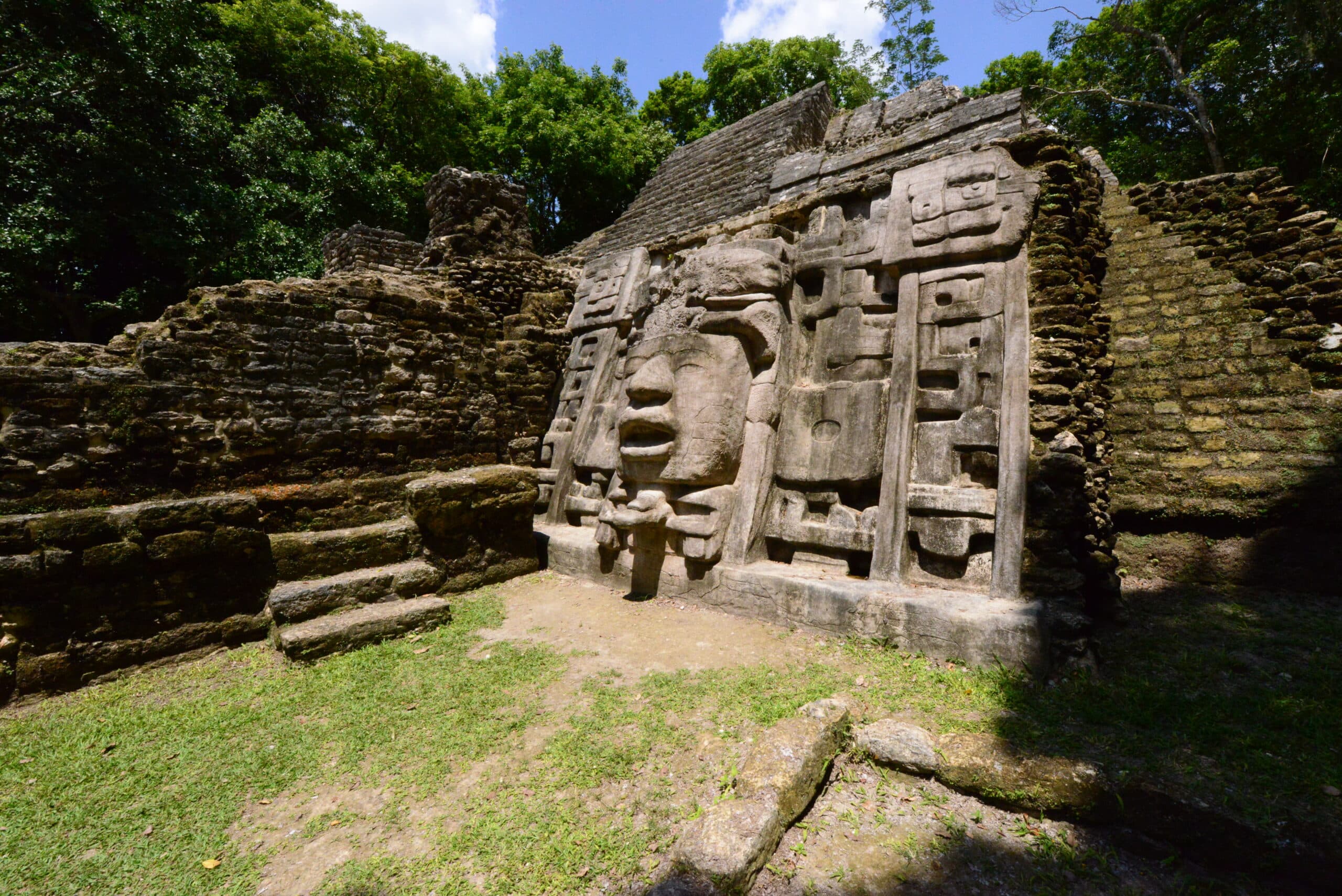
Featuring 13-foot high stone masks of a deified king, wearing a crocodile headdress.
Faces of the Past
The "Mask Temple" is perhaps Lamanai's most famous structure. Elaborately carved limestone masks flank the central staircase, representing a Mayan ruler. These masks are unique for their preservation and the artistic detail of the "Crocodile" motifs—a direct reference to the site's name, "Lama'an/ayin," which means "Submerged Crocodile."
Historical Layering
Like many Mayan structures, the Mask Temple was built over multiple centuries. The masks you see today are shells over even older, perfectly preserved earlier versions of the temple buried beneath.
Crocodile Symbolism
The crocodile was a powerful symbol for the Maya of Lamanai, representing the earth floating in a primordial sea. It was a bridge between the aquatic and terrestrial worlds.
The High Temple
Rising 108 feet above the plaza, the High Temple (N10-43) offers one of the most breathtaking views in Belize. After a steep climb, you are rewarded with a 360-degree panorama of the New River Lagoon and the seemingly endless expanse of the Orange Walk rainforest.
33 Meters
Apex Height
100 BC
Construction Era
Persistence Through the Ages: Lamanai's 3,000-Year Occupancy
What makes Lamanai truly exceptional is its longevity. While many Mayan centers were abandoned during the "Classic Collapse" of 900 AD, Lamanai remained a flourishing city. Its continuous occupancy lasted from roughly 1500 BC until the Spanish arrival in the 16th century—and even beyond. This persistence was largely due to its strategic location on the New River Lagoon, which provided a stable water source and a direct trade link to the Caribbean Sea. The residents of Lamanai were masters of aquatic trade, exporting honey, salt, and cacao to the rest of the Mayan world.
Colonial Encounters: The Spanish & British Legacy
Lamanai is one of the few places in Belize where you can witness the literal intersection of Mayan and European history. At the southern edge of the site lie the ruins of two Spanish "Visita" churches, built in the 16th century in an attempt to convert the local Mayan population. The attempt was unsuccessful; the Maya eventually revolted and burned the churches. Later, in the 19th Century, a British sugar mill was established on the site. Today, you can see the massive iron flywheels and vats of the mill, now being slowly embraced by the jungle—a powerful visual reminder of the overlapping waves of history that have washed over this landscape.
The Sounds of the Chiquibul: Howler Monkey Dynamics
As you walk through the jungle paths of Lamanai, you will almost certainly be serenaded by the Yucatan Black Howler Monkey (Alouatta pigra). Their roar, which can be heard for up to three miles, is one of the loudest sounds in the animal kingdom. These monkeys are an integral part of the Lamanai ecosystem, serving as primary seed dispersers for the local hardwoods. The presence of healthy howler populations is a biological indicator of a thriving, intact rainforest. Watching a troop move through the canopy above the Jaguar Temple is an experience that bridges the gap between archaeology and ecology.
Eco-Safari Logistics: Birding on the New River
The New River is a Mecca for ornithologists. During the boat safari, keep your binoculars ready for the Jabiru Stork—the largest flying bird in the Americas—as well as the Northern Jacana, which appears to "walk on water" over the lily pads. Snail Kites, Kingfishers, and various species of Herons are also common. To maximize your wildlife sightings, we recommend taking the earliest possible boat from Orange Walk (typically 9:00 AM). The cooler morning air encourages the fauna to be active near the river banks, providing a spectacular prelude to the archaeological wonders of the city.
Safari Essentials
Sun Protection
The 60-minute boat ride is largely uncovered. A wide-brimmed hat, long sleeves, and reef-safe sunscreen are critical to prevent severe tropical sunburn on the water.
Footwear
The site is largely grass and dirt paths. Lightweight hiking shoes or sturdy sandals are fine. Note that the climb up the High Temple is steep; footwear with good traction is recommended.
Into the
Serpentine.
Experience the ultimate blend of ancient mystery and wild nature. Secure your spot on the New River Safari today.