The Stone
Woman
A majestic civic ceremonial center dominating the Mopan River Valley.
Dominating the Valley
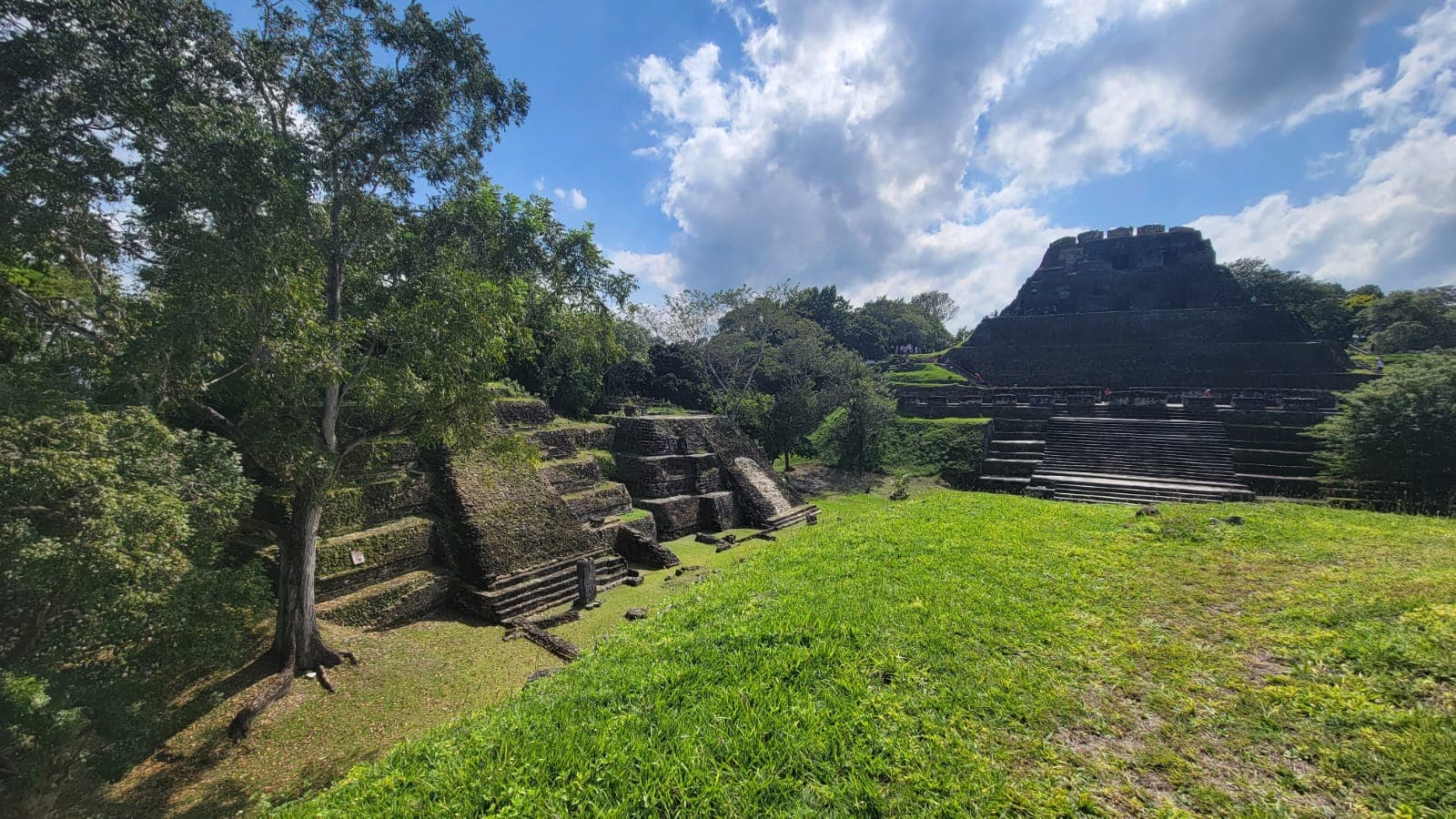
Located atop an artificially leveled limestone ridge above the Mopan River, well within sight of the Guatemalan border, Xunantunich served as a major ceremonial center during the Classic Period. To reach it, visitors must cross the river on a hand-cranked ferry, an experience that instantly transports you out of the modern era and into the rhythm of the jungle.
While lacking the sprawling, city-sized footprint of Caracol, Xunantunich is a marvel of vertical engineering. At its peak in 800 AD, it was home to nearly 10,000 residents and served as the political capital of the Belize River Valley, commanding trade and asserting dominance over neighboring sites like Cahal Pech.
El Castillo
130 feet of solid limestone engineering.
.jpg&w=3840&q=75)
Scaling the
Summit
The site's defining structure is Structure A-6, widely known as "El Castillo." Rising 130 feet above the main plaza, it remains one of the tallest man-made structures in all of Belize. The arduous, steep climb up its limestone steps is rewarded with an unmatched 360-degree panoramic view of the Macal River Valley and nearby Guatemala. But El Castillo wasn't just built for the view; it was a profound statement of power and a central hub for astronomical observation and elite ritual.
The Stucco Friezes
About two-thirds of the way up El Castillo, you will encounter the famous stucco friezes that wrap around the structure. Though the ones visible today are fiberglass replicas designed to protect the fragile originals buried beneath, they are exact 1:1 scale models. They depict the birth of a god associated with the royal family, the Tree of Life (the axis mundi connecting the underworld, earth, and heavens), and Ixchel, the moon goddess.
Tree of Life
Axis Mundi
Ixchel
Moon Goddess
Chac
Rain Deity
The Legend of the Stone Woman
The original Maya name for the city has been lost to time. The name "Xunantunich" translates to "Stone Woman" or "Maiden of the Rock" in the Yucatec Maya language. This moniker arose from an enduring piece of 19th-century folklore. Local villagers repeatedly reported seeing the ghostly apparition of a tall, striking woman dressed in traditional white Maya garb, with glowing red eyes. According to the legend, she would appear entirely solid, ascend the monumental staircase of El Castillo, and then smoothly pass through the solid stone wall into the temple itself.
The persistence of these sightings gave the ruins an aura of spiritual taboo, which ironically helped protect the site from excessive looting before formal archaeological work began in the 1890s by Thomas Gann.
Astronomy & Architecture
Xunantunich is a masterclass in archaeoastronomy. The layout of the plazas and the positioning of the temples were not arbitrary; they were strictly aligned with celestial events. The main plaza was built to serve as a massive sundial and calendar, with the central structures aligning perfectly with the solstices and equinoxes. This allowed the priesthood to accurately track the seasons, a critical function for an agricultural society reliant on perfectly timed planting and harvesting. When the shadow of El Castillo hits the central stelae on the winter solstice, you are witnessing an architectural calculation over a thousand years old.
The Ball Court & Ritual Conflict
Just off to the side of the main procession way lies the ancient ball court. The Mesoamerican ballgame was far more than a sport; it was a deeply religious and political event that reenacted the myth of the Hero Twins descending into the underworld (Xibalba) to battle the lords of death. Games at Xunantunich were likely high-stakes affairs, sometimes used to resolve political disputes between rival city-states without resorting to all-out warfare. Archaeological findings here suggest that high-ranking captives may have been forced to play, with the outcome literally determining life or death.
Logistics & Visitor Pro-Tips
To get the most out of your visit, try to arrive shortly after the site opens at 8:00 AM. You will beat the intense midday heat and avoid the crowds from cruise ship excursions that tend to arrive around 10:30 AM.
Wear sturdy shoes with good grip. The limestone steps on El Castillo have been polished smooth by centuries of rainfall and modern foot traffic, and they can be exceptionally slippery. Bring plenty of water, as there are no heavy concessions once you cross the river on the hand-cranked ferry.
Conquer the
Temple.
Cross the Mopan River and delve into the political heart of the ancient Maya.